
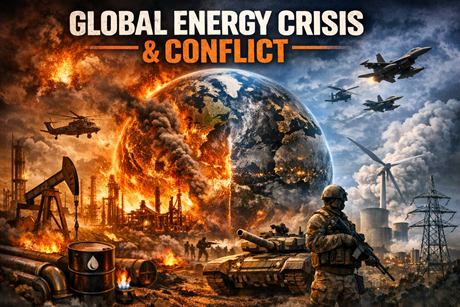
🌍 Global Energy Crisis & Conflict
The world is currently witnessing a major geopolitical crisis centered in the Middle East. The ongoing conflict involving Iran, Israel, and the United States has led to widespread instability across the region. One of the most significant consequences of this conflict has been the disruption of global energy supplies.
A key factor behind this crisis is the strategic importance of the Strait of Hormuz, a narrow waterway through which a large portion of the world’s oil supply passes. Due to military tensions and partial closure of this route, oil transportation has been severely affected. As a result, global oil prices have surged, impacting economies worldwide.
Countries across Asia and Europe are facing serious challenges. In several nations, governments have introduced emergency measures such as fuel rationing, reduced industrial activity, and financial relief packages to control the crisis.
India, which depends heavily on imported energy, is also affected. The government is preparing for increased electricity demand during summer and is relying more on coal reserves to avoid power shortages.
Meanwhile, diplomatic efforts are ongoing. Various countries and international organizations have called for ceasefire negotiations, but tensions remain high. The situation highlights how regional conflicts can have global economic and social consequences.
📝 Questions (Passage 1)
🔹 Objective (1 mark each)
- What is the main cause of the global energy crisis?
- Why is the Strait of Hormuz important?
- Which countries are mainly involved in the conflict?
- What has happened to oil prices?
- What steps are countries taking to manage the crisis?
🔹 Inferential (2 marks each)
- Why are Asian countries more affected by the crisis?
- How does the crisis show global interdependence?
- Why is India increasing coal usage?
🔹 Vocabulary
- Meaning of “geopolitical”
- Opposite of “disruption”