
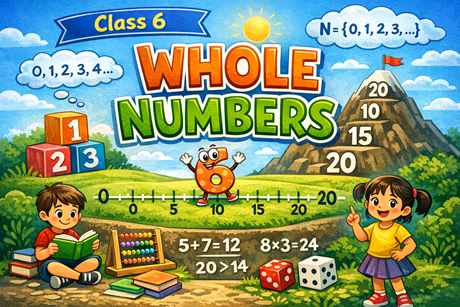
🔢 1. Introduction to Whole Numbers
Whole numbers are the numbers we use for counting along with zero.
👉 Whole Numbers = 0, 1, 2, 3, 4, 5, …
📌 Key Points:
- Smallest whole number = 0
- No largest whole number
- Whole numbers do not include:
- Negative numbers (−1, −2, …)
- Fractions (½, ¾, …)
🔍 2. Natural Numbers vs Whole Numbers
| Natural Numbers | Whole Numbers |
|---|---|
| 1, 2, 3, 4… | 0, 1, 2, 3… |
| Start from 1 | Start from 0 |
👉 Whole Numbers = Natural Numbers + 0
🔄 3. Successor and Predecessor
➤ Successor:
The number that comes just after a given number.
👉 Formula:
Successor of a number = Number + 1
Example:
Successor of 25 = 26
➤ Predecessor:
The number that comes just before a given number.
👉 Formula:
Predecessor = Number − 1
Example:
Predecessor of 25 = 24
📌 Important:
- 0 has no predecessor in whole numbers
➕ 4. Properties of Whole Numbers
🔹 (a) Closure Property
- Whole numbers are closed under addition and multiplication
✔ Examples:
2 + 3 = 5
4 × 5 = 20
❌ Not closed under subtraction:
3 − 5 = −2 (not a whole number)
🔹 (b) Commutative Property
a+b=b+aa + b = b + aa+b=b+a
✔ Works for:
- Addition
- Multiplication
✔ Examples:
3 + 4 = 4 + 3
2 × 6 = 6 × 2
❌ Not valid for:
- Subtraction
- Division
🔹 (c) Associative Property
(a+b)+c=a+(b+c)(a + b) + c = a + (b + c)(a+b)+c=a+(b+c)
✔ Works for:
- Addition
- Multiplication
✔ Example:
(2 + 3) + 4 = 2 + (3 + 4)
🔹 (d) Identity Property
- Additive Identity = 0
👉 a + 0 = a - Multiplicative Identity = 1
👉 a × 1 = a
✔ Example:
7 + 0 = 7
9 × 1 = 9
🔹 (e) Distributive Property
a×(b+c)=a×b+a×ca \times (b + c) = a \times b + a \times ca×(b+c)=a×b+a×c
✔ Example:
3 × (4 + 2) = 3×4 + 3×2 = 12 + 6 = 18
➖ 5. Whole Numbers on Number Line
- Whole numbers can be shown on a number line
- 0 is the starting point
- Numbers increase as we move right
👉 Uses:
- Comparing numbers
- Performing addition and subtraction
🔁 6. Patterns in Whole Numbers
Whole numbers follow clear patterns:
➤ Counting by 1:
1, 2, 3, 4, 5…
➤ Counting by 2:
2, 4, 6, 8…
➤ Counting by 5:
5, 10, 15, 20…
➤ Counting by 10:
10, 20, 30…
👉 Patterns help in:
- Mental maths
- Faster calculations
🧠 7. Important Observations
- Whole numbers are infinite
- Every number has:
- A successor
- Only 0 does NOT have:
- A predecessor
⚠️ 8. Common Mistakes to Avoid
❌ Thinking 0 is a natural number
❌ Applying commutative property to subtraction
❌ Forgetting 0 has no predecessor
❌ Mixing whole numbers with integers
✍️ 9. Practice Examples
Example 1:
Find successor of 999
👉 1000
Example 2:
Find predecessor of 500
👉 499
Example 3:
Use distributive property:
4 × (5 + 3)
👉 4×5 + 4×3 = 20 + 12 = 32
Example 4:
Check closure under subtraction:
7 − 9 = −2 ❌ Not a whole number
📌 10. Quick Revision (Exam Booster)
- Whole numbers = 0, 1, 2, 3…
- Smallest = 0
- No largest number
- Closed under:
- Addition ✔
- Multiplication ✔
- Not closed under subtraction ❌
- 0 → No predecessor