
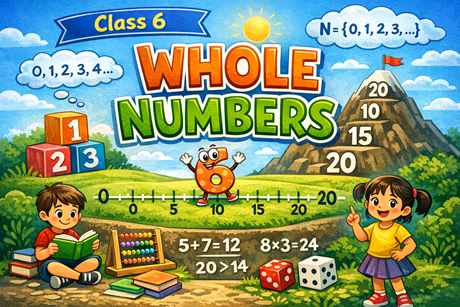
🔍 What this Exercise Covers
Exercise 2.2 focuses on the properties of whole numbers, especially:
- Closure Property
- Commutative Property
- Associative Property
- Distributive Property
- Identity Property
➕ 1. Closure Property
👉 A set is said to be closed if the result of operation stays in the same set.
✔ For Whole Numbers:
- Addition ✔
- Multiplication ✔
Examples:
2 + 3 = 5 (whole number)
4 × 5 = 20 (whole number)
❌ Not Closed:
- Subtraction → 3 − 5 = -2
- Division → 5 ÷ 2 = 2.5
🔄 2. Commutative Property
a+b=b+aa + b = b + aa+b=b+a
- Order does not matter
✔ Works for:
- Addition
- Multiplication
Examples:
5 + 3 = 3 + 5
4 × 2 = 2 × 4
❌ Not true for:
- Subtraction
- Division
🔗 3. Associative Property
(a+b)+c=a+(b+c)(a + b) + c = a + (b + c)(a+b)+c=a+(b+c)
- Grouping does not matter
✔ Works for:
- Addition
- Multiplication
Example:
(2 + 3) + 4 = 2 + (3 + 4)
🧮 4. Identity Property
- Additive Identity → 0
👉 a + 0 = a - Multiplicative Identity → 1
👉 a × 1 = a
Example:
7 + 0 = 7
9 × 1 = 9
➗ 5. Distributive Property
a×(b+c)=a×b+a×ca \times (b + c) = a \times b + a \times ca×(b+c)=a×b+a×c
Example:
3 × (5 + 2) = 3×5 + 3×2 = 15 + 6 = 21
⚠️ Important Observations
- Subtraction and division do NOT follow most properties
- Always check which operation is used
🔢 Section A: Identify the Property (1–10)
- 6 + 4 = 4 + 6
- (2 + 5) + 3 = 2 + (5 + 3)
- 9 × 1 = 9
- 7 × (3 + 2) = (7×3) + (7×2)
- 8 × 5 = 5 × 8
- (4 × 2) × 3 = 4 × (2 × 3)
- 10 + 0 = 10
- 3 × 6 = 6 × 3
- (1 + 2) + 3 = 1 + (2 + 3)
- 12 × (5 + 1) = (12×5) + (12×1)
✍️ Section B: Fill in the Blanks (11–20)
- 8 + 0 = ______
- 15 × 1 = ______
- 7 + 3 = 3 + ______
- (6 + 2) + 5 = 6 + (______ + 5)
- 9 × (4 + 1) = (9×4) + (9×______)
- 5 × 7 = ______ × 5
- (3 × 4) × 2 = 3 × (______ × 2)
- 10 + ______ = 10
- 1 × ______ = 25
- 6 × (2 + 3) = (6×2) + (______×3)
🧠 Section C: True or False (21–30)
- Whole numbers are closed under addition
- Whole numbers are closed under subtraction
- Multiplication is commutative
- Division is associative
- 0 is additive identity
- 1 is multiplicative identity
- Subtraction is commutative
- Multiplication is associative
- Whole numbers are closed under division
- Addition is associative
🔄 Section D: Solve Using Properties (31–40)
- 25 × (6 + 4)
- 12 × (5 + 5)
- (20 + 30) + 40
- 99 × 8
- 7 × (9 + 1)
- 50 × (3 + 7)
- (15 × 2) × 5
- 8 × (25 + 5)
- 100 × (2 + 3)
- 9 × (11 + 9)
🔍 Section E: Reasoning Questions (41–45)
- Why is subtraction not closed for whole numbers?
- Give one example to show multiplication is commutative
- Why is 0 called additive identity?
- Is division associative? Give reason
- Which property is used in: 6 × (4 + 2)?
🧩 Section F: Case-Based Questions (46–50)
📦 Case Study: Shop Items
A shopkeeper packs items in boxes. Each box contains 10 items. One day, he packs (5 + 3) boxes.
- How many boxes are packed in total?
- Find total items using distributive property
- Which property is used in this calculation?
🏫 Case Study: Classroom Groups
A teacher divides 24 students into groups of 6.
- Is division of whole numbers always a whole number? Explain
- What will be the result of 24 ÷ 6?
✅ Answer Key
Section A
- Commutative
- Associative
- Identity
- Distributive
- Commutative
- Associative
- Identity
- Commutative
- Associative
- Distributive
Section B
- 8
- 15
- 7
- 2
- 1
- 7
- 4
- 0
- 25
- 6
Section C
- True
- False
- True
- False
- True
- True
- False
- True
- False
- True
Section D
- 25×6 + 25×4 = 150 + 100 = 250
- 12×5 + 12×5 = 60 + 60 = 120
- 90
- 792
- 7×9 + 7×1 = 63 + 7 = 70
- 50×3 + 50×7 = 150 + 350 = 500
- 15×(2×5) = 15×10 = 150
- 8×25 + 8×5 = 200 + 40 = 240
- 100×2 + 100×3 = 200 + 300 = 500
- 9×11 + 9×9 = 99 + 81 = 180
Section E
- Because result can be negative
- Example: 3 × 5 = 5 × 3
- Because adding 0 does not change number
- No, grouping changes result
- Distributive property
Section F
- 8 boxes
- 10×5 + 10×3 = 50 + 30 = 80 items
- Distributive property
- No, sometimes result is not whole number
- 4