
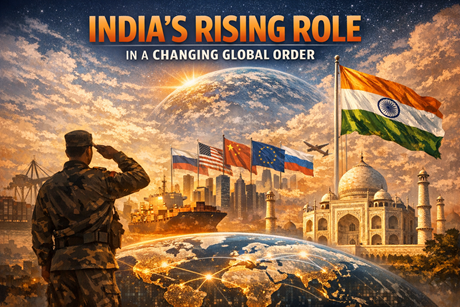
✍️In the 21st century, the global order is undergoing rapid transformation due to technological advancements, shifting economic power, and increasing geopolitical complexities. Amid these changes, India is emerging as a significant global player, shaping international discourse through its economic strength, technological innovation, and diplomatic balance.
One of the key pillars of India’s rising influence is its success in building robust Digital Public Infrastructure (DPI). Platforms like UPI and Aadhaar have revolutionized governance and financial inclusion within the country. More importantly, India is now sharing these digital solutions with other developing nations, enhancing its global standing as a provider of scalable and inclusive technology. This model of digital empowerment not only strengthens international partnerships but also positions India as a leader in the digital economy.
Another critical area where India is asserting its global role is in sustainable development. As a signatory to the Paris Agreement, India has committed itself to reducing carbon emissions and expanding renewable energy capacity. The country’s focus on solar and wind energy reflects a balanced approach between economic growth and environmental responsibility. By championing climate action while addressing developmental needs, India sets an example for other emerging economies.
India’s strategic push towards self-reliance, especially in defence manufacturing, further strengthens its global position. Under initiatives promoting domestic production, India has reduced dependency on imports and increased exports of defence equipment. This shift not only enhances national security but also contributes to economic growth and technological advancement.
In the field of education and human capital, reforms under the National Education Policy 2020 aim to prepare a future-ready workforce. By emphasizing skill development, critical thinking, and digital learning, India is investing in its demographic dividend. A well-educated and skilled population is essential for sustaining long-term growth and innovation.
On the global stage, India maintains a balanced and independent foreign policy. It actively participates in international organizations and forums while maintaining strategic autonomy. In times of geopolitical tensions, India often plays a constructive role by promoting dialogue and stability. This balanced diplomacy enhances its credibility as a responsible global power.
Economically, India continues to be one of the fastest-growing major economies. Despite global challenges such as inflation and economic slowdown, institutions like the International Monetary Fund recognize India’s resilience and growth potential. Its expanding market, growing middle class, and increasing foreign investments make it an attractive destination for global business.
However, India’s rise is not without challenges. Issues such as income inequality, infrastructure gaps, and external geopolitical pressures require continuous attention. Addressing these challenges effectively will determine the sustainability of India’s growth trajectory.
In conclusion, India’s rising role in a changing global order is marked by its achievements in technology, sustainability, economic growth, and diplomacy. By continuing reforms and strengthening international cooperation, India is well-positioned to become a leading force in shaping the future of the world. Its journey reflects not only national progress but also a broader vision of inclusive and sustainable global development.