
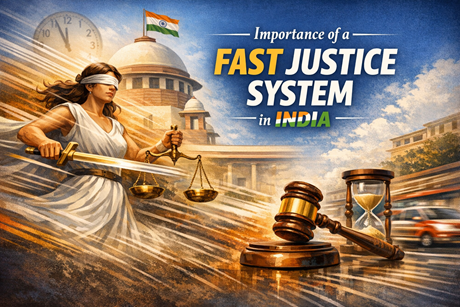
Importance of a Fast Justice System in India
Justice is the foundation of any civilized society. A nation can progress only when its citizens have faith that fairness and law will protect their rights. In India, however, the justice delivery system has long been burdened with delays, making the phrase “justice delayed is justice denied” a harsh reality. Therefore, building a fast and efficient justice system is not just a need—it is a necessity for the nation’s growth and stability.
One of the biggest challenges in India’s legal system is the enormous number of pending cases. Courts at various levels are overwhelmed, and cases often take years, sometimes decades, to reach a conclusion. This delay not only frustrates citizens but also weakens their trust in the system. For a common person seeking justice, time is as important as the judgment itself. Delayed justice can lead to financial loss, emotional stress, and even loss of hope.
To address this issue, modern solutions such as Alternative Dispute Resolution (ADR) have gained importance. Institutions like the Institute of Company Secretaries of India are promoting ADR methods like arbitration, mediation, and conciliation. These methods help resolve disputes outside traditional courts in a quicker and more cost-effective manner. ADR is especially useful for business disputes, family matters, and small-scale conflicts, where lengthy court procedures can be avoided.
A fast justice system also plays a crucial role in economic development. Investors and businesses are more likely to operate in a country where legal disputes are resolved quickly and fairly. Efficient legal processes improve the ease of doing business, attract foreign investment, and support entrepreneurship. Moreover, a strong justice system ensures law and order, which is essential for a peaceful and prosperous society.
However, improving the justice system requires more than just alternative methods. There is a need for judicial reforms, including increasing the number of judges, using technology for e-courts, and simplifying legal procedures. Digitalization can help track cases, reduce paperwork, and speed up hearings. Legal awareness among citizens is equally important so that people can make informed decisions and avoid unnecessary litigation.
In conclusion, a fast justice system is the backbone of a strong democracy. It protects citizens’ rights, strengthens trust in the government, and promotes economic growth. India must continue to adopt innovative solutions and reforms to ensure that justice is not only delivered but delivered on time. Only then can the true spirit of justice prevail, making the nation fair, strong, and progressive.